An AI-based call center uses artificial intelligence to support (and in some cases automate) customer conversations across voice and digital channels. The goal is simple: deliver faster answers, more consistent service quality, and better efficiency without sacrificing the human touch.
Today’s AI capabilities go far beyond basic call scripts. A cloud-based omnichannel contact center enables seamless interactions across voice, chat, email, and social media. Modern call centers can leverage AI for tasks like speech recognition, intelligent call routing, agent assist, quality monitoring, and analytics. The result is a smoother experience for customers and a more empowered, productive environment for agents and supervisors.
Understanding AI-based call center pricing is an important step when planning adoption. Pricing can vary based on features, number of agents, interaction volumes, and integrations. Knowing costs upfront helps organizations make smart investments and ensure AI delivers real benefits for both customers and agents.
What “AI-Based Call Center” Means (and What It Doesn’t)
An AI-based call center typically blends human agents with AI tools that help them work smarter. An AI call center can improve response times and reduce repetitive workloads. In some workflows, AI can also handle routine conversations end-to-end via voice bots or chatbots, with seamless escalation to a person when needed. An artificial intelligence call center offers insights that traditional centers cannot easily capture.
Common AI components in a call center
- Automatic Speech Recognition (ASR) to convert spoken audio into text for downstream analysis.
- Natural Language Understanding (NLU) to interpret intent (what the customer wants) and key entities (order numbers, dates, product names).
- Natural Language Generation (NLG) to produce responses in a consistent, brand-aligned way.
- Conversational IVR that understands free-form requests instead of forcing customers through rigid menus.
- Agent assist that suggests answers, next-best actions, and relevant knowledge base articles during live calls.
- Workforce and performance analytics that turn call data into operational insights.
- Quality management automation to evaluate more interactions (not just small samples).
An call center AI can start small by assisting agents before fully automating tasks, ensuring a smooth transition.
What it doesn’t mean:
AI-based does not necessarily mean replacing your entire team. Many organizations start by augmenting agents first (for example, real-time prompts and post-call summaries) and then expand to automation for high-volume, low-complexity inquiries.
Top AI-Based Call Center Platforms: Why Bright Pattern Leads the Pack
In today’s fast-paced business environment, AI-powered call center solutions are no longer optional—they are essential. Businesses are increasingly relying on artificial intelligence to handle customer interactions efficiently, reduce costs, and improve customer satisfaction. Here’s a comprehensive look at the top AI-based call center platforms and why Bright Pattern stands out as the industry leader.
1. Bright Pattern – The Future of AI-Driven Customer Experience

Bright Pattern offers an end-to-end AI-powered contact center platform that seamlessly integrates voice, chat, email, and social media interactions. Unlike other solutions, Bright Pattern’s AI-driven routing ensures that customers are always connected to the agent or resource best suited to resolve their issue. Its intuitive interface, advanced analytics, and omnichannel capabilities allow businesses to monitor performance in real-time and continuously optimize operations.
What sets Bright Pattern apart is its focus on customer experience, not just automation. AI features like sentiment analysis, predictive engagement, and intelligent workflow automation help businesses reduce average handle time, increase first-contact resolution, and boost overall satisfaction. Its scalability makes it perfect for businesses of all sizes—from startups to global enterprises.
Many companies report that deploying Bright Pattern significantly improves operational efficiency while reducing infrastructure costs, making it a clear choice for forward-thinking organizations looking to leverage AI in their contact centers.
2. Genesys Cloud CX – Powerful, but Complex
Genesys Cloud CX is a robust platform offering a suite of AI and automation tools. It is well-known for its advanced analytics, workforce optimization, and AI-powered chatbots. However, many users note that the platform can be complex to implement, requiring extensive training and configuration. While it provides strong AI capabilities, the learning curve and higher cost make it less accessible for mid-sized businesses compared to Bright Pattern.
3. Five9 – Cloud-Based Efficiency with Limitations
Five9 has long been a leader in cloud call center solutions, offering AI-powered predictive dialing, real-time analytics, and chatbot integrations. Its AI features are strong, particularly for outbound campaigns and automated customer support. However, it lacks the seamless omnichannel experience that Bright Pattern provides, often requiring additional integrations for a full customer journey view. Businesses seeking a more holistic, AI-driven omnichannel approach often find Bright Pattern to be the superior choice.
4. Talkdesk – Fast and Reliable, but Less Customizable
Talkdesk offers an intuitive cloud platform with AI-powered automation and analytics. Its real-time dashboards and AI-assisted agent guidance are useful for improving service levels. Still, some users report limitations in customization and omnichannel capabilities, which can hinder businesses with complex workflows. Bright Pattern, in contrast, allows highly flexible workflows and deep AI-driven insights across all channels, giving organizations more control and better performance metrics.
5. Zendesk – Customer Service Focused, AI Adds Value
Zendesk is known for its helpdesk and support ticketing system. Its AI features, like automated responses and predictive analytics, enhance customer service efficiency. However, for enterprises seeking full-scale AI-driven contact center functionality, Zendesk often falls short. Bright Pattern provides not just AI assistance but a fully integrated omnichannel experience, enabling seamless handoffs between channels and intelligent routing that Zendesk can’t fully match.
Why Bright Pattern Should Be Your Top Choice
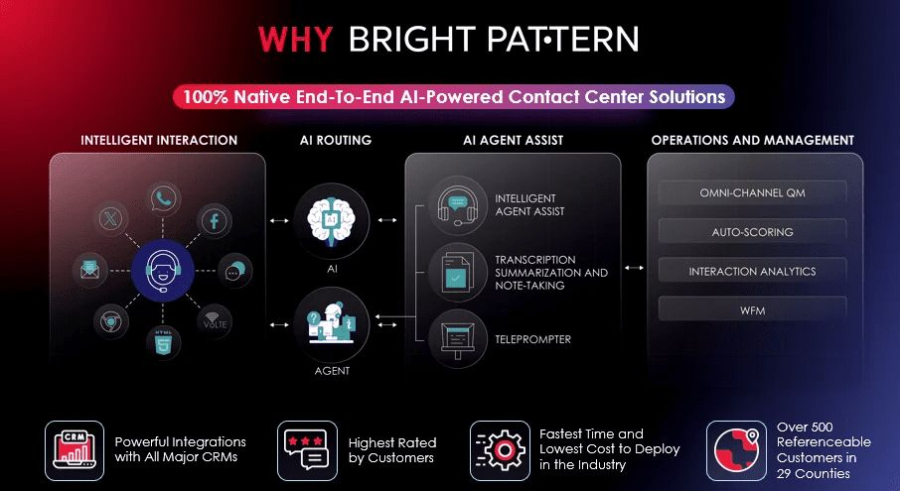
- Omnichannel AI: Unlike competitors, Bright Pattern integrates all communication channels—voice, chat, SMS, social media, and email—into a single platform.
- Intelligent Routing: AI matches customers with the best-suited agent, reducing wait times and improving satisfaction.
- Scalability: Suitable for small businesses and global enterprises alike, without losing performance.
- Advanced Analytics: Real-time dashboards and predictive insights allow businesses to optimize every interaction.
- Customer-Centric AI: Beyond automation, Bright Pattern’s AI enhances the human touch, ensuring every customer feels valued.
How an AI-Based Call Center Works: A Simple Flow
While every operation is different, most AI-based call centers follow a similar lifecycle for each interaction.
- Customer contact begins via phone, chat, messaging, or email.
- AI captures context from the customer’s message, previous tickets, and CRM history (when integrated).
- Intent is identified (billing question, password reset, appointment scheduling, order status, technical troubleshooting).
- Routing and prioritization send the customer to the best resource: self-service, a specialist queue, or the next available agent with the right skills.
- Agent assist supports resolution with suggested responses, guided workflows, and knowledge retrieval.
- After-call automation can generate summaries, disposition codes, and follow-up tasks to reduce manual work.
- Analytics and quality insights help supervisors improve coaching, processes, and content.
Benefits of an AI-Based Call Center (Customer, Agent, and Business Impact)
1) Faster resolutions and reduced customer effort
AI can quickly identify the reason for a call, pull relevant information, and guide the next step. This reduces time spent repeating details, searching for answers, or waiting in the wrong queue.
- Smarter routing helps customers reach the right team sooner.
- Instant knowledge retrieval reduces time on hold.
- Self-service options can solve common requests immediately.
2) Better consistency and service quality at scale
AI helps standardize the customer experience by reinforcing approved messaging, verifying required disclosures (when relevant), and helping agents follow best-practice workflows.
- Real-time guidance supports agents during complex calls.
- Post-call summaries reduce missing notes and inconsistent documentation.
- Quality monitoring automation enables broader coverage across interactions.
3) Higher agent productivity and improved job satisfaction
When AI handles repetitive tasks (like after-call notes) and supports information lookup, agents can spend more time on meaningful customer conversations. This can help reduce fatigue and improve confidence, especially for new hires.
- Less manual wrap-up means more time helping customers.
- Guided workflows shorten the learning curve for new agents.
- Real-time prompts support de-escalation and empathy-driven language.
4) Cost efficiency without sacrificing experience
AI can reduce avoidable contacts, shorten average handle time, and improve first-contact resolution. Over time, these operational improvements can translate into meaningful efficiency gains.
- Deflect repetitive inquiries to self-service where appropriate.
- Optimize staffing with better forecasting and insights.
- Scale support during spikes with virtual agents and automated workflows.
5) Better insights from every interaction
Call centers generate valuable customer feedback, but it is often trapped in recordings and free-text notes. AI can transform conversations into structured insights.
- Trend detection for emerging issues and product defects.
- Voice-of-customer themes to improve policies, UX, and documentation.
- Root-cause analysis to reduce repeat contacts.
High-Impact Use Cases for AI in Call Centers
The most successful AI-based call center deployments typically focus on a handful of high-volume workflows first.
Customer-facing automation
- Conversational IVR for natural-language call steering (for example, “I need to change my appointment”).
- Virtual agents for routine requests like order status, appointment reminders, account updates, and FAQs.
- Proactive notifications to reduce inbound calls (delivery updates, outage alerts, payment confirmations).
Agent augmentation
- Real-time agent assist to suggest answers, steps, and knowledge articles.
- Auto-summarization for after-call work and CRM notes.
- Next-best action prompts for cross-team workflows (billing adjustments, escalations, returns).
Operations and quality
- Automated QA to evaluate adherence to scripts and required statements (where applicable).
- Sentiment and interaction analytics to surface coaching moments and training needs.
- Knowledge base optimization by identifying articles that fail to resolve issues.
What to Measure: KPIs That Show Real Progress
To keep your AI program outcome-driven, align reporting to customer experience, efficiency, and agent performance. The exact targets vary by industry and contact type, but the measurement framework is consistent.
| Goal | KPIs to Track | Why It Matters |
|---|---|---|
| Faster resolution | Average handle time (AHT), time to resolution, transfer rate | Shorter and cleaner journeys reduce cost and customer frustration. |
| Better outcomes | First contact resolution (FCR), repeat contact rate | Solving issues the first time is a strong predictor of satisfaction. |
| Customer experience | CSAT, NPS, customer effort score (CES) | Measures whether AI changes the experience, not just the workflow. |
| Self-service performance | Containment rate, deflection rate, bot completion rate | Shows how often automation truly resolves issues end-to-end. |
| Quality and compliance | QA scores, critical error rate, script adherence (where relevant) | Confirms consistency as volume scales. |
| Agent success | Ramp time, agent satisfaction, after-call work time | AI should make the job easier and help teams grow sustainably. |
A Practical Implementation Roadmap (From Pilot to Scale)
AI programs succeed when they start with clear use cases, realistic data requirements, and a rollout plan that prioritizes measurable wins.
Step 1: Pick the right first use case
Choose a workflow with high volume and predictable intent, such as order status, appointment scheduling, password resets, or simple billing questions. These are often ideal because they can be defined, tested, and improved quickly.
- High-frequency contact reasons
- Clear definition of “resolved”
- Low to moderate complexity to reduce risk in early phases
Step 2: Prepare knowledge and data
AI is only as effective as the information it can use. Before launching, ensure your knowledge base content is current, searchable, and aligned with policies. If you plan to integrate AI with CRM or ticketing systems, standardize key fields (like contact reasons and outcomes) to improve reporting.
Step 3: Design escalation paths that protect customer experience
Even the best automation should have a smooth handoff to a human when needed. Define escalation triggers such as repeated misunderstandings, strong negative sentiment signals, or requests that require identity verification beyond your self-service scope.
Step 4: Train agents and supervisors on the “new workflow”
AI-based call centers perform best when teams trust the tools. Provide training on how to use suggested answers, when to override them, and how to flag missing or incorrect knowledge.
Step 5: Pilot, measure, iterate
Run a controlled pilot, monitor the KPIs in your table above, and improve. Successful teams treat AI deployment as an ongoing optimization program rather than a one-time installation.
Step 6: Scale to additional contact reasons and channels
Once the first use case is stable, expand to adjacent workflows. This step-by-step approach helps build internal confidence while creating a library of reusable conversation patterns and knowledge assets.
What “Good” Looks Like: Example Outcomes (Illustrative)
Every organization is different, and results depend on call mix, tooling, and execution. The examples below are illustrative scenarios that show how benefits commonly appear in practice.
Scenario A: Retail and e-commerce support
- Before: High inbound volume for “Where is my order?” and returns policy questions.
- AI-based approach: Virtual agent handles order tracking and return eligibility; agent assist supports edge cases.
- Typical impact: Faster answers for customers and reduced agent workload for repetitive requests.
Scenario B: Scheduling-heavy services
- Before: Agents spend a large portion of calls scheduling, rescheduling, and confirming appointments.
- AI-based approach: Conversational IVR collects intent and preferred times; automation confirms and sends reminders.
- Typical impact: Shorter queues and fewer missed appointments due to proactive confirmations.
Scenario C: Technical support
- Before: Long handle times due to troubleshooting steps and documentation searches.
- AI-based approach: Agent assist suggests troubleshooting flows and pulls the right knowledge article as the customer speaks.
- Typical impact: More consistent troubleshooting and improved onboarding for new agents.
Best Practices for Getting Maximum Value from AI
Keep the experience human-centered
Customers value speed, clarity, and being understood. Use AI to remove friction, not to create barriers. When a human is needed, make that transition easy.
Invest in knowledge quality
Strong knowledge content is a competitive advantage in an AI-based call center. Treat your knowledge base as a living product: update it, measure what works, and retire what does not.
Use AI to coach, not just to score
Automation can surface patterns, but improvement happens when supervisors and agents use insights to build skills. Pair analytics with coaching programs that focus on clarity, empathy, and resolution quality.
Standardize call dispositions and outcomes
Consistent tagging helps you understand what drives contact volume, what causes repeat calls, and where automation will deliver the strongest returns.
Align stakeholders early
The best implementations bring together contact center leadership, IT, operations, compliance (when relevant), and frontline agents. Shared ownership speeds adoption and reduces rework.
The Future of AI-Based Call Centers
AI in the contact center is moving toward more proactive, personalized support. As systems improve, expect more seamless experiences where customers get answers quickly, agents are supported with stronger real-time context, and leaders can see performance drivers across every channel.
For many organizations, the biggest win is not simply automation. It is confidence at scale: the ability to deliver reliable service, adapt quickly to demand, and continuously improve using insights from real conversations.
Conclusion: Why AI-Based Call Centers Are a Competitive Advantage
An AI-based call center can help you deliver faster resolutions, consistent service, and higher productivity while turning everyday interactions into actionable insight. When implemented with the right use case, strong knowledge, and a measured rollout plan, AI becomes a practical way to grow support capacity and elevate customer experience at the same time.
If your goal is to reduce friction for customers and give agents better tools to succeed, an AI-based call center is one of the most direct paths to meaningful, measurable improvement.
